
YouTube video ideas: how to find ones you can repeat
The best YouTube video idea is one you can make twenty more times: a single repeatable format, not a list of 105 unrelated one-offs. Ads pay nothing until 1,000 subscribers and 4,000 watch hours, and that takes a run of videos.
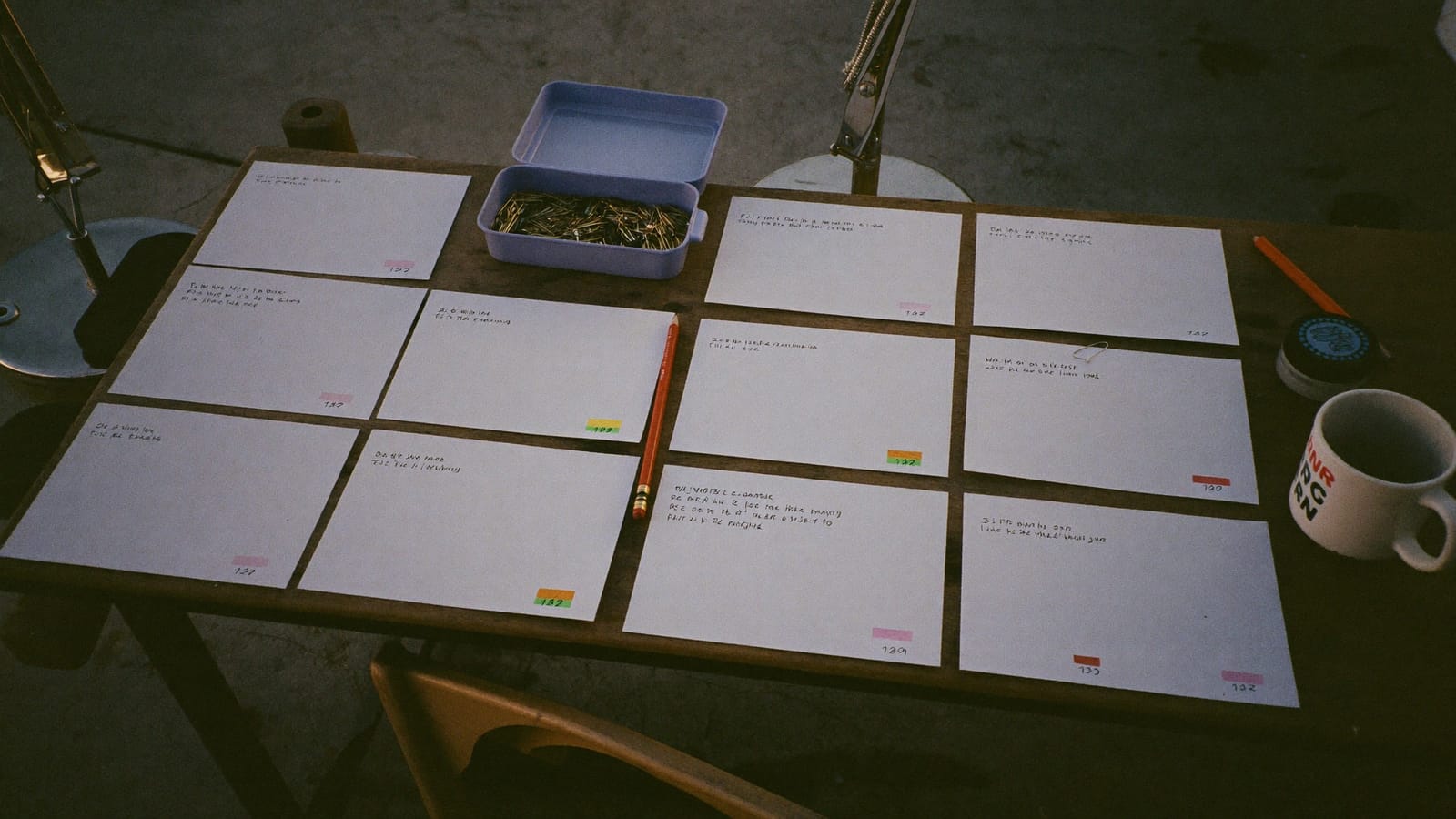
Pick a format, then write twenty titles
Ideas are not scarce. Repeatable ideas are.
A format is a promise plus a shape: what the viewer gets, and how the video delivers it. "How one small town lost its railway, told in twelve minutes over archive photographs" is a format. "Funny video" is not.
Once you have a format, the ideas arrive in batches. Swap the town. Swap the year, the company, the ship, the court case, the demolished building.
So do this instead of reading another list. Write twenty titles inside one format, in one sitting. If you run dry at six, the format is too narrow or the subject is too small. If you reach twenty in half an hour, you have your first six months.
An idea you can make once is an afternoon. An idea you can make forty times is a channel.
Why a list of 105 ideas leaves you stuck
VEED's guide sorts 105 YouTube video ideas into beginner videos, how-tos, reviews, funny videos, lists and kids videos. Skillshare's list of 18 opens with how-to and tutorials, product reviews and unboxing, vlogs, and reaction and commentary videos. Jasper's starts with a channel trailer, day-in-the-life vlogs and a review of your essential tools.
None of that is wrong. It is the wrong unit. Those are categories of thing that exist, collected after the fact. They tell you what has been made, not what you can make forty of without hating your life.
A post in r/NewTubers puts the real question plainly: the writer has a channel with a friend and is struggling to find ideas that would get good views. That is the actual search. Not "what could I film", but "what will be watched, and what comes after it".
Idea generators have the same gap. Renderforest offers a free tool that produces video ideas on demand. It will give you combinations. It cannot tell you which one you can still stand on video number thirty, which is the only test that matters.
The math that tells you how many ideas you need
Ads only pay inside the YouTube Partner Program, and the level that pays ad revenue needs 1,000 subscribers plus 4,000 qualified watch hours on public long-form videos in the last 365 days, or 10 million qualified Shorts views in 90 days. Hours watched on Shorts in the Shorts Feed do not count toward the 4,000.
4,000 hours is 240,000 minutes watched. That number is the one that decides how many ideas you need.
Work an example. Say your videos run ten minutes and the average viewer stays four minutes. 240,000 divided by 4 is 60,000 views. Spread over 20 videos, that is 3,000 views each. Spread over 50 videos, 1,200 each.
Pick your own average instead of mine, because yours will be different. The shape of the answer does not change: the threshold is a body of work, not a hit. One viral video that nobody finishes gets you less than twenty small ones that people watch to the end.
There is an earlier gate too. YouTube's first level of the Partner Program needs 500 subscribers, 3 qualified uploads in the last 90 days, and 3,000 qualified watch hours in 365 days (or 3 million Shorts views in 90 days). It opens memberships, Supers, gifts and Shopping. It does not pay ad revenue. That starts at the second level.
If you want the numbers for your own channel rather than my worked example, the money calculator does the division for you, including how many more views you need. The full checklist lives in YouTube monetization requirements.
Five places real ideas come from
Not a list of 105. A list of five sources that keep producing.
- The search box. Type your subject into YouTube and read what the box completes it with. Those are phrases people type, in their words. Each one is a title.
- Your comments and your inbox. The question somebody asks under video four is video eleven. People tell you what they did not understand.
- One video split into parts. If a video took twelve minutes and three of them were the interesting bit, that bit is its own video. The long one proved there was an appetite.
- The question behind the question. "What is the best X" sits on top of "how do I tell X apart from Y", "what happens when X fails", "who made the first X". One topic, four videos.
- A channel you admire, read for structure only. Count its chapters. Time its cold open. Write down what its thumbnails promise, in words. Then apply that structure to your own subject. That is the part worth copying, and the only part you are allowed to.
Idea shapes that survive repetition
Trena Little's list of first-video ideas names shapes rather than topics: how-to, comparisons, reviews, screen tutorials, case studies, mistakes. That is a more useful way to think than a themed list, because a shape takes any subject you own.
The ones that batch well:
- How one thing was built or broken. Same structure, new object each time.
- A versus B, decided on three tests. The tests stay. The pair changes.
- The mistake. What people get wrong about one specific thing, and what happens next.
- A timeline. Year by year, one subject per video.
- The number. One statistic, taken apart, where it came from, who it is wrong for.
Notice what these have in common. The viewer knows what they are getting from the title, and you know what you are making before you start researching. That second part is what lets you publish on a schedule instead of staring at a blank page on a Tuesday night.
Check your first three before you make ten more
Make three, then read your own numbers rather than anyone's advice.
Take the watch time and the view count for each video and divide. Watch hours times 60, divided by views, gives you minutes watched per view. Compare that across the three. The one people stayed with is your format, whatever you felt about it while editing.
YouTube Analytics also shows RPM, which is what you earned per thousand views after YouTube's share, across every revenue type. That only exists once you are in the program, and it is worth knowing it is a different thing from CPM, which is what advertisers pay before YouTube takes its cut. On the watch page, partners get 55% of net ad revenue; YouTube's own help page says there is no guarantee about how much, or whether, you get paid at all.
Ideas YouTube will not pay for
Some formats are easy to repeat precisely because nothing in them changes, and that is the trap.
On July 15, 2025, YouTube renamed its "repetitious content" policy to "inauthentic content". It does not monetize mass-produced or repetitive content: similar videos with minimal variation and low narrative value, the same character in the same situation again and again, image slideshows or scrolling text with minimal narrative, and AI-generated content built from generic or unoriginal templates.
It does allow a shared intro and outro when the bulk of each video differs, and a series with recurring characters where each episode has its own storyline. The reused content policy draws a parallel line: no clips from someone else's show stitched together without a narrative, nothing copied without substantive change, nothing that only reads out material you did not write. Clips inside a critical review are fine, as is other people's footage cut into your own storyline and commentary.
The practical reading: the template can repeat, the substance cannot. That is also why a format is the thing to borrow from a channel you admire, never its footage. At AutomationChannels we study the shape of a channel, the length, the pacing, what the thumbnails promise, and then research and write something original on your subject. If a plan depends on reusing the other channel's work, it is not a plan, it is a demonetization notice with a delay on it.
One more rule to know before you commit to a schedule: a channel that has not uploaded or posted for six months or more can lose monetization.
Who this does not work for
If you want one video to go big and then stop, none of this helps. Pick a lottery with better odds.
If you are bored by your subject at idea three, you will be unbearable at idea thirty, and viewers hear it. Pick a different subject while it costs you nothing.
And if you cannot publish on a rhythm, the math above never closes. Twenty videos at one a month is nearly two years. At one a week it is five months.
So the next thing to do is not to read another list. Open a blank page, write twelve titles in one format, and strike every one you could not make a second time with a different subject. What survives is the channel. If the survivors line up in an order, that is a series: planning 3 to 12 parts in one go is how a series gets made without stalling in month two. If nothing survives, the format was the problem, not you, and choosing a subject that lasts is the step you skipped.